


How to Choose a Large Golf Trophy: Size, Materials & Budget Guide for Tournament Organizers
Oct 29, 2026
Leave a message
Choose the Trophy for the Event, Not Just for Its Height
A large golf trophy should reflect what the tournament means to the people who win it. For an annual club championship, it might become a permanent part of the club's history. For a corporate golf day, it may need to showcase a sponsor's identity. For a major invitational, the trophy might serve as the centerpiece of the awards ceremony.
Before choosing a design, consider three things: who will receive the award, where it will be displayed, and what information needs to appear on it. These decisions influence the trophy's size, shape, base, engraving area, and budget.
There is also an important distinction between a trophy that stays with one winner and a perpetual trophy that passes to a new champion each year. The first can be personalized as a keepsake. The second needs a practical way to record successive winners without making the design look crowded.
Getting these details right at the beginning makes it easier to compare designs and avoid unnecessary customization.

1. How Large Should a Golf Trophy Be?
There is no universal height requirement for a large golf trophy. The right dimensions depend on the venue, the design, the display space, and how the award will be handled.
Use these ranges as an initial design guide:
|
Approximate height |
Suitable use |
What to consider |
|
40–50 cm (16–20 in) |
Club events and smaller tournaments |
Easier to handle and fit on a shelf |
|
50–70 cm (20–28 in) |
Annual championships and major club events |
Creates a stronger visual presence |
|
Above 70 cm (28 in) |
Prominent ceremonial awards and display pieces |
Requires closer attention to stability, weight, and transport |
These are practical comparison ranges, not official golf-trophy standards.
Height alone does not determine visual impact. A broad cup with balanced handles and a substantial base can look more impressive than a taller, narrow design. A large sculpted figure can also change the overall proportions, even when the base is relatively compact.
Check the full height, base width, and overall silhouette together. If the trophy will be displayed in a clubhouse cabinet, measure the available space before approving the design. For an award presented on stage, consider whether the recipient can lift and hold it comfortably.
Decide whether the trophy is a keepsake or a perpetual award
A personal championship trophy usually records one winner and one event. The engraving can include the tournament name, year, winner's name, and perhaps a club or sponsor logo.
A perpetual trophy has a different job: it records a succession of champions. It may need an engraving plate with space for multiple names and years, or a design that allows the winner record to be updated without replacing the entire trophy.
This affects the base design, plate dimensions, and long-term maintenance. Plan the available space for future winners before production begins. A plate that looks sufficient for the first year may become difficult to read after several seasons.
2. Choose a Material for the Design You Want
Material choice should follow the design, not the other way around. A classic cup, a detailed golfer figure, and a sculptural golf-themed centerpiece place different demands on manufacturing and finishing.
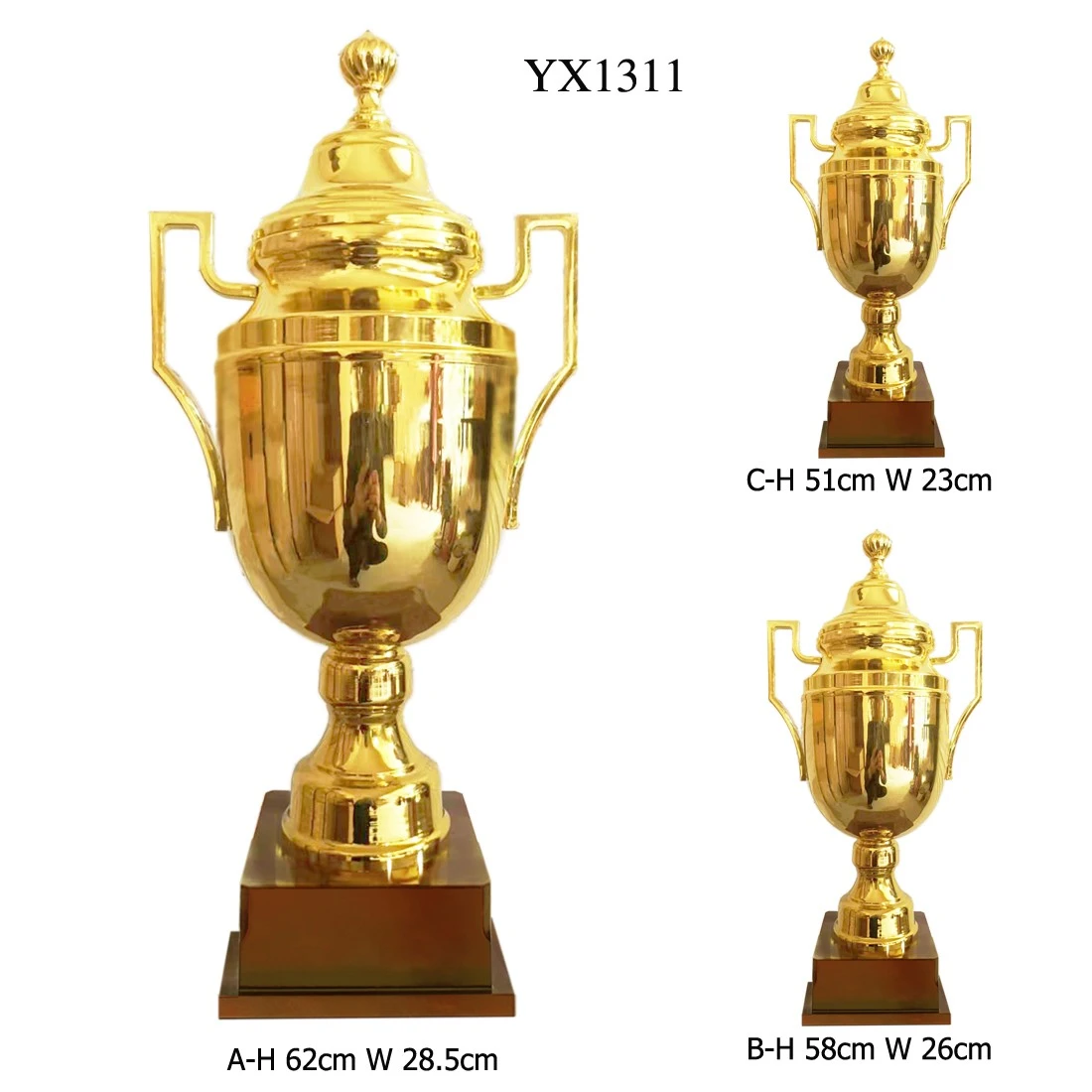
For a traditional championship look, a metal cup is a natural starting point. Its proportions, handles, stem, and base create the visual character of the award. If you are comparing a Metal Trophy Cup Award, pay attention to the shape and finish of the cup as well as the engraving area. The word "metal" alone does not tell you how refined or substantial the finished trophy will look.
Zinc alloy is useful when the design includes detailed figures, emblems, decorative handles, or custom shapes. Casting allows these elements to take form, while the finishing process determines the final surface appearance. For buyers, the practical checks are the clarity of fine details, the quality of visible edges, the alignment of assembled parts, and the consistency of the finish.
Resin suits sculptural designs that do not follow a conventional cup shape. It can be used for golf figures and decorative forms, making it worth considering when the design concept is the main attraction. Review the actual surface finish and the strength of narrow or projecting features rather than judging the material from a rendering alone.
Some custom trophies combine materials to balance appearance and structure. In those designs, the way the parts connect matters as much as the individual materials. A polished cup, a sculpted figure, and a decorative base should look like one coherent award rather than separate components assembled without visual balance.

How manufacturing affects the finished appearance
Mold making, casting, plating, and final assembly all influence the result.
A well-planned mold helps establish the intended shape and repeatability of cast components. Casting creates the form, while surface preparation and plating affect the appearance of metallic finishes. Assembly determines whether the cup, figure, stem, and base align properly.
For tournament organizers, these are not just factory processes. They influence whether fine details remain clear, whether the finish looks consistent across multiple awards, and whether the finished trophy matches the approved design. When reviewing a supplier's work, ask to see actual product photographs or a sample with a similar level of detail and finish.

3. Get the Design and Engraving Right Before Production
A strong design gives the trophy a clear focal point. That might be a traditional cup, a golfer in mid-swing, a golf ball motif, or an emblem representing the club or event.
The engraving should support that focal point rather than compete with it. Start by deciding which details are essential:
- Tournament or championship name
- Event year
- Winner's name or award category
- Club or sponsor logo
If the winner changes every year, a replaceable nameplate is often more practical than permanently engraving changing information into the main body. For a perpetual trophy, plan enough space for future winners and establish how names will be added over time.
What causes sample revisions?
Sample revisions often happen when the approved concept leaves room for interpretation. A logo may look too small on the actual base, the text may be difficult to read, the proportions may feel different from the original rendering, or the finish may not match the organizer's expectations.
These issues are easier to resolve before bulk production. The design proof should show the overall dimensions, logo placement, text layout, main colors, and important structural details. If a physical sample is included in the order, use it to review the actual size, stability, visible joins, finish, and engraving legibility.
Keep feedback specific. Instead of asking for the trophy to "look better," identify what needs to change: the logo size, plate position, cup proportions, surface finish, or another visible detail. This gives the design and production teams a clear direction for the revision.
Before approving the final design, make sure the person responsible for the event has checked spelling, dates, logos, and award titles. Correcting these details before production is far simpler than dealing with an entire batch of personalized trophies afterward.
Browse the golf trophy collection to compare cup styles and golf-themed designs. A reference image, preferred height, quantity, and engraving details will help narrow the options.
4. How to Plan Your Large Golf Trophy Budget
The price of a custom trophy depends on its construction and the work required to produce it. Size matters, but so do the mold, material, decorative details, finish, personalization, packaging, and order quantity.
Existing design, modified design, or new mold?
An existing design is a practical starting point when its shape already suits the event. You may only need to customize the finish, logo, engraving plate, or other available details.
A modified design sits between standard and fully custom. It can preserve the main structure while changing selected features, although the effect on tooling and production depends on the changes involved.
A new mold provides more control over the overall silhouette and decorative details. It also adds upfront design and tooling work, so it makes the most sense when the custom shape is important to the identity of the event.
|
Design approach |
Main benefit |
Budget consideration |
|
Existing design |
Less development work |
Limited changes to the overall shape |
|
Modified design |
Retains a proven structure with selected customization |
Changes may add setup or tooling costs |
|
New custom mold |
Greater freedom over shape and detail |
Includes additional tooling and design work |
Why order quantity matters
Some costs occur before the first trophy is completed. When tooling or setup costs apply, ordering more pieces can spread those costs across a larger quantity.
However, a larger order does not automatically guarantee a lower total cost. Material, finishing, packaging, and individual personalization still affect the quotation. Ask suppliers to price the same specifications and quantities so you can make a fair comparison.
Where can you save without weakening the result?
Start with the details that buyers and recipients will notice most: the main silhouette, finish, engraving, and stability. An existing cup design with a personalized base may be a better investment than a completely new mold for an event that does not require a unique shape.
You can also simplify decorative elements, reduce the number of finishes, or use a replaceable plate for changing winner information. Avoid cutting costs by overlooking the base, structural connections, or protective packaging. A damaged trophy or a poorly finished surface can undermine the presentation even if the original quote looked attractive.
For an accurate comparison, provide the same dimensions, materials, finish, logo requirements, quantity, packaging expectations, and delivery destination to each supplier.
5. Plan Production Around the Event Date
A tournament has a fixed date; a custom trophy order has several stages that need to fit before it. Design approval, sample review where applicable, production, finishing, packing, and shipping should all be considered when setting the schedule.
An existing design with straightforward personalization generally involves fewer design decisions than a trophy that requires a new mold or a complex combination of materials. The more distinctive the design, the more important it is to settle the main details before production begins.
When requesting a quotation, provide the required delivery date and destination as well as the quantity. Ask the supplier to clarify which stages are included in the estimated schedule and whether shipping time is included.
For a major championship or an annual presentation, leave time for the organizer to review the design and approve any sample before the full order proceeds. Assign one person to consolidate feedback so that different reviewers do not send conflicting instructions about the logo, proportions, or engraving.

6. Build an Award Set That Reflects the Tournament
A golf tournament may need more than one trophy, but every award does not need to compete for attention.
The main championship trophy should carry the strongest visual identity. It might be larger, more distinctive, or designed as a perpetual trophy that returns to the club each year. Other awards-such as runner-up, longest drive, or closest to the pin-can use a related style with simpler detailing or smaller dimensions.
This creates a clear hierarchy: the champion receives the centerpiece, while the supporting awards still look like part of the same event. Using a shared finish, base style, or emblem helps tie the set together without making every trophy identical.
The quantity and design should follow the actual award categories. Before ordering, list each category, recipient, personalization requirement, and whether the award will be retained by the winner or returned for the following year. This is particularly important for perpetual trophies, where the main award and the individual winner's keepsake may serve different purposes.
7. Request a Quotation Based on Clear Specifications
JYB produces custom metal craft and trophy products, with manufacturing processes that include mold making, casting, plating, and finishing. The company's background in trophy production can be explored through its company and manufacturing information.
To make the first quotation more useful, share:
Preferred height and base dimensions
Material and finish
Reference image, drawing, or design concept
Logo and engraving requirements
Quantity and award categories
Required delivery date and destination
If you are comparing a conventional cup with a sculpted golf design, tell the supplier which visual features matter most. If the trophy is intended for repeated annual use, explain whether it needs to accommodate future winners' names.
The product category metal sports cups and trophies can also help you compare traditional cup-style awards. For a golf-specific order, use the event requirements to narrow the design rather than choosing by height or product photo alone.

Frequently Asked Questions
Q: What Size Is Suitable For A Large Golf Trophy?
A: For initial comparison, 50–70 cm (20–28 in) is a useful range for annual championships and major club events. Designs above 70 cm (28 in) may suit prominent ceremonial displays, while 40–50 cm (16–20 in) can work for smaller events. These are planning ranges, not official standards; always consider the trophy's proportions and display space.
Q: Should We Choose A Perpetual Trophy Or An Individual Winner's Trophy?
A: Choose a perpetual trophy when the same award will pass from one champion to the next each year. It needs a practical way to record future winners. An individual trophy is better suited to a recipient who keeps the award permanently and may prefer personalized engraving.
Q: Is A Metal Golf Trophy Better Than A Resin Design?
A: The better choice depends on the design. Metal cups suit traditional championship awards, while zinc alloy can support detailed decorative components. Resin is useful for sculptural forms. Compare the finished appearance, construction, and packaging requirements before choosing.
Q: Does A Custom Large Golf Trophy Need A New Mold?
A: No. An existing design may work if its shape meets the event's requirements and the customization can be achieved through finishes, logos, or engraving. A new mold is more relevant when the overall silhouette or decorative structure needs to be created specifically for the tournament.
Q: What Information Should I Provide For A Trophy Quotation?
A: Provide the dimensions, material, finish, logo and engraving details, quantity, delivery destination, and required date. A reference image or sketch can help the supplier understand the design and identify the most suitable production approach.
Q: How Can I Avoid Problems When Approving A Custom Trophy?
A: Review a drawing or visual proof that shows the dimensions, proportions, logo position, text layout, and key structural details. If a physical sample is included, check its size, stability, visible joins, finish, and engraving before approving bulk production.

The right large golf trophy is defined by more than its height. It should suit the tournament's status, look balanced in its display setting, carry the right information, and remain practical to handle and maintain.For an annual club championship, consider whether a perpetual trophy would become part of the club's tradition. For a corporate or invitational event, focus on the design details that make the award recognizable and memorable. Once the purpose is clear, material, tooling, personalization, and budget decisions become easier to evaluate.
Explore the golf trophy range and share your design reference, dimensions, quantity, and event date to discuss a suitable option.