


How to Choose the Right Sports Medals and Trophies for a Competition
Oct 10, 2026
Leave a message

Choosing sports medals and trophies looks simple until an order goes wrong. A cup arrives at half the size shown online. A team name is misspelled on the plate. The budget forgets the boxes, ribbons and shipping. Most of these problems can be avoided by making decisions in the right order.
This guide follows that order: event level, trophy or medal, material, size, sport-specific details, cost, timing, choosing a supplier, and safety rules. We are a manufacturer, and the advice comes from the orders we handle for schools, clubs and tournaments. Figures such as sizes, prices and lead times are typical ranges from our own work, not official standards, and we say so where it matters. You will also find sport-specific advice on volleyball trophies and awards and on football team trophies.
Why the Right Award Matters
A trophy is more than a piece of metal or resin. For a ten-year-old, it is proof that effort pays off. For a club, it is something to display and show new members. For a sponsor or organizer, it is a small billboard that stays in a home or office for years.
Many players keep their medals and trophies for a long time and photograph them the same day. That photo often goes online with your event name and logo attached. A light, badly finished award sends the wrong message. A solid, well-made one makes people say the event was properly run.
A Youth Tournament That Almost Went Wrong
An organizer of a youth football (soccer) tournament contacted us three weeks before the final. The trophies from his first supplier had arrived 12 cm tall, while the online listing had shown 25 cm. The champions' cup looked smaller than the display box holding the runner-up medals, and parents were already asking questions.
We could not solve everything in three weeks. We produced a small batch of metal cups as quickly as our schedule allowed , and he used the original small pieces as participation awards.
The practical takeaway: get the exact height, weight and material in writing, and ask for a photo of a real sample next to a ruler or a familiar object. Website pictures do not show scale.
Start With These Five Questions
Answer these before you look at any catalog. They make your quote request much clearer and save time later.
Q: What is the level of your event?
A: A neighborhood fun run and a regional championship need different awards. A school event may be well served by resin trophies and printed medals. A national league final calls for something heavier, such as a metal cup or a crystal award. Match the award to the importance of the moment.
Q: How many awards do you need?
A: Count everyone: first, second and third place, MVPs, best goalkeeper or setter, fair play and any special awards. Then add 5–10% for spelling mistakes, late entries and transit damage. Ordering everything at once is almost always cheaper per unit than several small orders.
Q: What is the budget per award?
A: Set a budget for each category, not just a total. You might spend more on the champion's trophy, less on the runner-up, and use medals for everyone else. Include packaging, shipping and import charges, not only the factory price.
Q: When is your deadline?
A: Work backward from the event date. Custom awards involve design approval, often a sample, production and shipping, and the total is longer than most first-time buyers expect. The timeline section below shows a full example. If your deadline is tight, tell the supplier on day one, because it changes which materials and processes are realistic.
Q: Do you need custom logos or engraving?
A: Most organizers do. A logo, event name and year make the award personal. Tell your supplier what artwork you have (vector files such as STL, CDR, AI, EPS or PDF are usually easiest to work with) and whether names must be engraved or printed on plates. If you need Arabic, Latin or bilingual text, as is common for Middle East events, say so early.
Trophy or Medal: Which Fits Your Competition?
Choose a trophy for a team or a top finisher, for an award that will be displayed at a club or school, or when you want a strong moment on stage. Trophies are visible from a distance, photograph well and suit champions and special awards like MVP.
Choose medals for large groups: marathon finishers, school sports day participants, or every player on the podium. They are light, cheap to ship and easy to personalize with ribbons in event colors. For hundreds of participants, bulk medals are the practical choice.
Use both for most tournaments. Give trophies to the top three teams and key individual awards, and give medals to every player. The best sports medals and trophies packages pair a few impressive pieces for the spotlight with good-looking medals for everyone else. You control the budget without leaving anyone out.
|
Factor |
Trophy |
Medal |
|
Best for |
Champions, teams, special awards |
Large groups, finishers, podium places |
|
Cost per piece |
Medium to high |
Low to medium |
|
Display value |
High |
Medium |
|
Shipping |
Heavier and bulkier |
Light and compact |
|
Personalization |
Plates, engraving, sculpted details |
Custom shape, color, ribbon, printing |
|
Typical order size |
1–100 pieces |
50–5,000+ pieces |
Trophy and Medal Materials in Plain English
Material decides how an award looks, how heavy it feels, how long it lasts and what it costs.
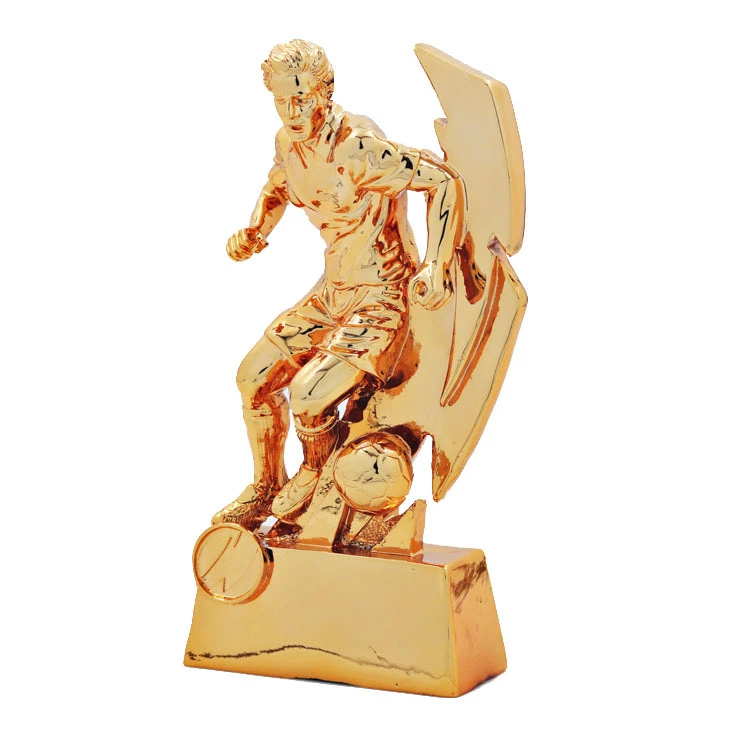
Resin. Polyresin is poured into molds, so it can hold very detailed shapes, such as a footballer mid-kick or a volleyball player mid-spike. It is light and affordable, and it is usually painted or electroplated in gold, silver or bronze. It can chip if dropped on a hard floor, so packaging matters.
Metal. Zinc alloy, brass and aluminum are the usual choices for cups. They feel heavier, last longer and are often plated in gold or silver. This is the classic championship look, and most clubs and leagues choose it for their main prize.
Crystal and glass. In trophy listings, "crystal" usually means optical or crystal glass. It looks clean and elegant, engraves sharply with a laser, and suits formal ceremonies and VIP awards. It is heavy and fragile, so it needs strong packaging.
Acrylic and wood. Acrylic offers a modern look with full-color printing and is light to ship. Wood gives a natural, traditional feel and suits school and community awards. If sustainability matters to your event, wood, bamboo or recycled materials are the better talking point, because acrylic is a plastic. Wood is best kept for indoor use, since damp and sun can warp it.
Medal materials. Zinc alloy is the most common choice because it flows well into detailed molds and takes plating (gold, silver, bronze, antique) and soft enamel color. Brass and iron are common for stamped, simpler designs. Acrylic medals are light and printable, which works well for children's events.
|
Material |
Typical weight (25 cm trophy) |
Durability |
Typical process |
Price level |
|
Polyresin |
300–600 g |
Medium |
Mold casting, painting, electroplating |
5 $ - 50 $ |
|
Zinc alloy |
800 g–2 kg |
High |
Die casting, plating |
15 $ - 80 $ |
|
Brass |
1–3 kg |
Very high |
Casting or stamping, polishing |
30 $ - 120 $ |
|
Aluminum |
300–700 g |
High |
Casting or machining, anodizing |
18 $ - 90 $ |
|
Crystal glass |
800 g–2.5 kg |
Medium (fragile) |
Cutting, laser engraving |
13 $ - 70 $ |
|
Acrylic |
150–400 g |
Medium-high |
Laser cutting, UV printing |
8$ - 40 $ |
Weights are typical ranges from our own production and vary with design and wall thickness.
Why weight matters: metals are much denser than resin (zinc alloy is roughly 6.6 g/cm³ against about 1.1–1.5 g/cm³ for polyresin). Because many trophies are partly hollow, a finished zinc alloy trophy is typically about two to three times heavier than a resin one of the same size, not the six times the densities alone would suggest. That weight is why metal feels premium in the hand, and why air freight on a big metal order can cost a lot.
What Size Should a Sports Trophy Be?
There is no single right size, because it depends on the level of the event. Use the table below as a starting point.
|
Event level |
Champion (cm) |
Runner-up (cm) |
Third place (cm) |
Individual award (cm) |
|
Kids / school (under 12) |
18–22 |
16–19 |
14–17 |
14–18 |
|
Youth (12–18) |
22–28 |
19–24 |
17–21 |
18–24 |
|
Adult / club |
28–40 |
24–34 |
21–29 |
22–30 |
|
League / national final |
40–60 |
34–50 |
29–42 |
30–40 |
These ranges reflect the orders we usually handle. They are a practical guide, not an official standard.
A simple hierarchy rule: if the champion's trophy is 100%, make second place about 85% and third about 70–75%. This keeps a clear visual order while giving everyone a real award. Individual awards such as MVP are normally a little smaller than the champion's cup.
Bigger is not always better. Size the champion's trophy to your podium, your budget and the person who has to carry it. Championship cups above roughly 40 cm need a heavy, stable base.
Medal sizes. Most sports medals are 50–70 mm in diameter and 3–5 mm thick. 50 mm suits children and large events, 60 mm is the all-round standard, and 70 mm gives a premium look for finals and marathons. Neck ribbons are commonly 22–25 mm wide.
Checking size online. Ask for the height in centimeters and compare it with something you know. A standard water bottle is about 20 cm tall.
Choosing by Sport: Volleyball, Football and More
Sport-specific details matter mostly for design, environment and award categories. Use the size table above for all sports.
Volleyball Trophies and Awards
Popular volleyball trophies and awards include a golden ball on a column, a spiking player figure on a base, a net-inspired cup, and a clean modern star or wing shape. On a tight budget, a resin figure on a marble-look base offers good value. For a large final, a big metal cup with a volleyball on the lid looks impressive on stage.
Beach or indoor? Sand, sun, salt air and humidity are hard on awards. For beach tournaments we suggest metal with quality corrosion-resistant plating or anodized aluminum, or acrylic that will not rust. Ask about plating quality and protective coatings, since finish is where beach awards fail. Indoor tournaments allow more delicate options, such as crystal or fine-detail resin figures.
What to prepare. Plan team trophies (1st–3rd), individual awards (MVP, best setter, best spiker, best libero, best server) and possibly a fair-play or spirit award. Keep individual trophies slightly smaller than the champion's cup so the hierarchy is clear on the podium. If you want your tournament logo on the trophies, send artwork early.
Football Team Trophies (Soccer)
Note for US readers: this section covers association football (soccer). American football awards follow different conventions.
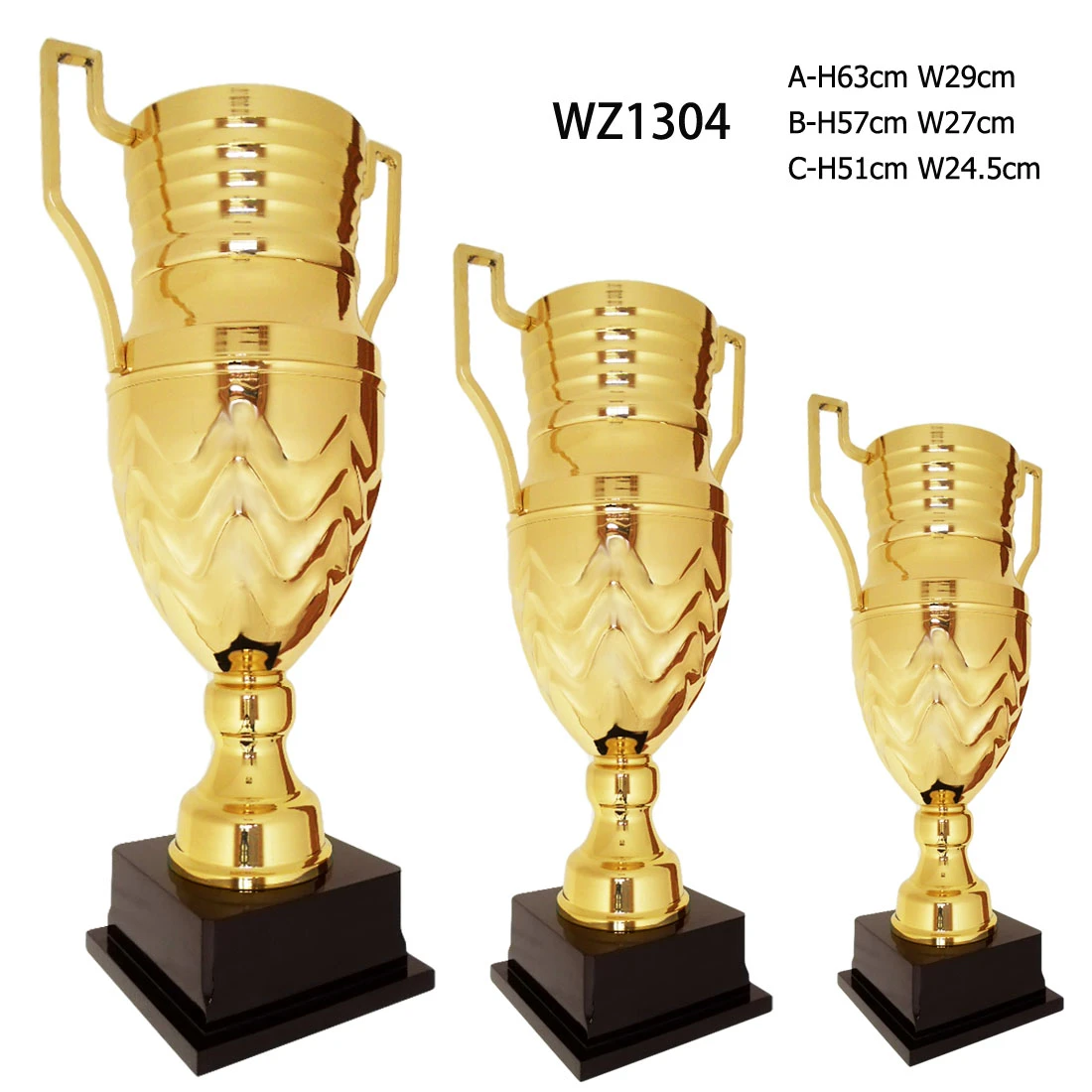
The champions' cup is the star: a large metal cup with handles, or a sculpted ball on a tall base. Around it you will usually want a Golden Boot for the top scorer, a Golden Glove for the best goalkeeper, an MVP award and a Fair Play award. Because football team trophies are often the biggest awards on the table, make sure the base is heavy enough that the cup does not tip during lifting and photos.
Youth leagues versus professional clubs. Youth trophies should be light enough for small hands and safe, with no sharp edges or loose small parts. Bright colors and fun shapes work well. Adult leagues and professional clubs tend to choose heavier metal cups with classic engraving. In our enquiries, buyers in the Middle East often ask for gold finishes and larger, more decorative designs, while European buyers often prefer cleaner, more traditional styles. These are patterns, not rules.
Perpetual trophies. A perpetual trophy stays with the organizer and passes to each year's winner, who keeps a small replica. Plan a base with room for many nameplates (a base that can hold at least 15–20 years of winners is a sensible starting point), choose a solid material such as zinc alloy or brass, and make sure the base can take extra plates later.
Team and player awards. A big team cup is great, but the small medal or mini trophy for each player is what goes home in a kid's bag. If the budget allows, give both.

Other Sports at a Glance
|
Sport |
Common award approach |
|
Basketball |
Figure or ball-on-base trophies for teams; medals for all players |
|
Running and marathons |
Finisher medals in bulk, larger medals for age-group winners |
|
Swimming |
Medals for placings, small trophies or plaques for records |
|
Martial arts and badminton |
Medals for divisions, trophies for overall champions |
How Much Do Custom Trophies and Medals Cost?
It depends on material, size, design detail and quantity. The ranges below show typical factory-direct unit prices.
|
Product |
Typical unit price (USD) |
|
Resin trophy, 15–25 cm |
$3–$30 |
|
Metal trophy cup, 25–40 cm |
$20–$200 |
|
Crystal trophy award |
$10–$60 |
|
Acrylic trophy plaque |
$3–$12 |
|
Zinc alloy medal, 60–70 mm, with ribbon |
$0.6–$2.5 |
Assumptions: standard or lightly customized designs, medium order quantities, factory price only. They exclude tooling, engraving plates, packaging, shipping and duties. For single pieces, very small runs or fully sculpted 3D designs, unit prices are higher. Always ask for a formal quote.
Hidden Costs Buyers Often Forget
Watch for mold fees on fully custom 3D designs, gift boxes or foam packaging, engraving plates, ribbons and lanyards, freight, import duties and VAT. Ask your supplier for the total landed cost, not just the price per piece.
How Bulk Orders Lower the Unit Price
The example below uses a custom zinc alloy medal with an assumed base price of $2.00 at 50 pieces. It is illustrative only, not a quote.
|
Quantity |
Approx. reduction |
Example price per medal |
|
50 pcs |
Baseline |
$2.00 |
|
300 pcs |
About 10–20% lower |
$1.60–$1.80 |
|
1,000 pcs |
About 25–40% lower |
$1.20–$1.50 |
If you run regular events, ordering enough for the whole season in one go usually saves the most.
Worked Example: An Eight-Team Youth Volleyball Tournament
Awards needed: 1 champion's cup, 2 team trophies (2nd and 3rd), 5 individual awards (MVP, best setter, best spiker, best libero, best server) plus 1 fair-play award, and medals for the 12 players on each of the top three teams (36 medals).
Spares (5–10%): 1 extra trophy and 4 extra medals, giving 10 trophies and 40 medals.
|
Item |
Quantity |
Unit range |
Subtotal |
|
Champion metal cup (22–28 cm) |
1 |
$8–$30 |
$8–$30 |
|
Team trophies, resin (2nd, 3rd) |
2 |
$3–$10 |
$6–$20 |
|
Individual and fair-play trophies, resin |
6 |
$3–$10 |
$18–$60 |
|
Spare trophy, resin |
1 |
$3–$10 |
$3–$10 |
|
Zinc alloy medals with ribbon |
40 |
$0.6–$2.5 |
$24–$100 |
|
Total (factory price only) |
$59–$220 |
That range does not include plates, packaging, shipping, duties or any mold fee for a custom-shaped medal. Use it as a planning baseline, then request a full quote.
How Long Does It Take? Build Your Timeline
Most trophy problems are really timing problems. Work backward from the day you need the awards in hand, not from the day of the event.
|
Stage |
Typical time |
|
Artwork, proof and design approval |
Allow about a week per round |
|
Custom sample (for new designs) |
15–35 days, depending on the product |
|
Sea freight to major European or US ports |
About 25–40 days |
|
Air freight |
About 5–10 days |
|
Safety buffer before the event |
At least 2 weeks |
Example (custom design, sea freight, worst case): 7 days approval + 35 days sample + 40 days shipping + 14 days buffer is already about 96 days, before bulk production time is added. That is why we suggest starting three to four months ahead for custom overseas orders. If you use an existing design and skip the sample, or use air freight, the schedule shortens, but it costs more.
The usual process is: send your idea or artwork, receive a design proof, approve it, make a sample, approve the sample, produce the full batch, run quality checks, pack and ship. A simple resin design or a standard medal is faster, while a fully sculpted 3D trophy with a new mold takes longer.
Choosing a Supplier: Manufacturer, Trading Company or Local Shop

Manufacturer. A custom trophy manufacturer makes products in its own workshop, so you get direct pricing, more control over quality and the ability to customize almost anything. The trade-offs for small buyers are sample fees, international freight and customs, time-zone communication, and a longer lead time.
Trading company. A trading company buys from factories and adds a margin. It can be convenient, especially if you want several product types from one contact, but you usually pay more and have less say over changes.
Local shop. A local shop is best for fast, small jobs and for anyone who wants to see the product in person. Prices per piece are usually higher and design options more limited.
For anything beyond a handful of pieces, factory-direct is usually cheaper, especially with custom designs. For a small, urgent order, a local shop can be the better choice.
Capacity and minimums. Ask any supplier about monthly capacity and minimum order quantity. Ours is about 500 trophies per month , and we accept orders from a single piece, though larger orders lower the unit price. For large orders, tell us your event date early so we can schedule batches.
Questions to Ask Before You Order
Are you the manufacturer or a trading company?
What is the exact size, weight and material?
Can I see a real photo or a sample before the bulk order?
What are the production and shipping times to my country?
What is included in the price: packaging, plates, ribbons?
What is your policy if there is a mistake in the finished order?
Can you provide test reports for children's products?
If you need awards under your own brand, also ask about logo packaging and private-label options.
Safety and Compliance
Rules depend on where the awards are sold or used, so check current regulations for your market and ask the supplier for test reports. This is general guidance, not legal advice; confirm details with your customs broker or a compliance specialist.
United States. The CPSIA sets limits for lead and other substances in children's products, meaning products designed or intended primarily for children aged 12 or younger. Whether a trophy or medal counts as a children's product depends on its design and how it is marketed, so ask a compliance specialist if you are unsure. California's Proposition 65 warnings can also apply to certain metals and coatings.
Europe. REACH restricts hazardous substances in consumer articles. It includes a limit on nickel release for items in direct and prolonged skin contact; how relevant that is for a medal on a ribbon depends on the design, so ask for test reports. REACH also restricts substances such as lead and cadmium in certain articles. EN 71 is the well-known toy safety standard, and buyers sometimes request it for children's awards as extra reassurance, even though medals are not toys.
Gulf markets. Importers may ask for conformity documents, and requirements vary by country and product. Tell us your destination early.
Small parts and sharp edges. For children's awards, avoid detachable small parts and sharp corners. Rounded edges, firmly fixed decorations and smooth finishing are simple safeguards. Medals should have no rough edges on the back.
Packaging and export documents. Export shipments need a commercial invoice, packing list and correct HS code, and some markets require a "Made in" label. Good packaging is also a safety matter: foam or molded inserts and strong cartons prevent breakage in transit.

What Organizers Are Asking For Now
These are patterns in the enquiries we receive, not statistics.
Personalization:
full-color printing on acrylic, custom-shaped medals with the event logo, and personalized nameplates, even on small orders.
Sustainable materials: requests for wood, bamboo, recycled plastics and recyclable metals, often from schools and public events in Europe.
Simpler designs:
clean shapes and mixed materials, such as metal with wood or acrylic, which also help control cost and weight.
Photo-friendly awards: reflective plating, clear shapes and space for a logo or hashtag, since winners photograph their awards.
Common Mistakes When Ordering Sports Awards
Send names and text in a copy-and-paste document, and have a second person proofread the proof.
Ask for height in centimeters and compare it with a familiar object.
Order 5–10% extra.
Sample first, especially for a new mold.
A cup without a stable base or proper box will not survive the journey.
The lowest quote often hides thin plating, low weight or poor packaging.
Quick Buying Checklist
Event level and number of awards confirmed
Trophy, medal or both decided
Material and size chosen
Budget set per award, including shipping and duties
Artwork, logo and text ready and proofread
Sample approved for custom designs
Lead time and shipping method agreed
5–10% spare quantity added
Safety documents requested if needed
Delivery date at least two weeks before the event
Frequently Asked Questions
Q: How much do custom trophies cost?
A: Most custom trophies cost about $10–$300 per piece from a factory, depending on size, material and design. Crystal awards can reach about $60. Resin and acrylic are the most affordable and metal costs more. Molds, engraving and packaging add to the total, so request a full quote.
Q: What is the best material for outdoor sports trophies?
A: Metal with good plating (zinc alloy or brass), anodized aluminum, and acrylic handle sun, rain and sand better than crystal or painted resin. Wood is best kept indoors. For beach events, ask about corrosion-resistant finishes.
Q: How long does custom trophy production take?
A: Custom samples take about 15–35 days depending on the product.
Shipping is extra. See the timeline section for a full example.
Q: What is the minimum order for custom medals?
A: We accept orders from one piece. Larger quantities lower the unit price, so combine your needs into one order when possible.
Q: What size trophy is best for kids' competitions?
A: For children's events, a champion's trophy of about 18–22 cm is a good range, with other placings a little smaller (14–19 cm). It is light, easy to hold and still looks like a proper award. Choose rounded edges and avoid small detachable parts.
Q: What should be engraved on a sports trophy?
A: Include the event name, the year, the award category (such as Champion or MVP), and the winner's name or team. A logo is optional but adds a professional touch. Keep the text short so it stays readable.
Q: Can I get a sample before a bulk order?
A: Yes, and we recommend it for any new custom design. Samples let you check size, weight, color and finish before production. See the timeline section for how long they take.
Q: Is it cheaper to buy directly from a factory?
A: Usually yes for larger quantities and custom designs, because you avoid a middleman's margin and get more control over materials and details. For a very small or urgent order, a local shop may be more convenient once you factor in samples, freight and customs.
Final Thoughts on Choosing Sports Medals and Trophies
The right sports medals and trophies match the moment: the level of the event, the people receiving it and the place it will end up. Once you know that, material, size and budget become much easier to decide, and the rest is timing and clear communication with your supplier. Start early, get specifications in writing, and check a sample for any custom work, whether you are ordering football team trophies for a league final, volleyball trophies and awards for a beach tournament or medals for a thousand runners.
If you would like help, send us your event type, the number of awards, your target budget and your deadline. We will suggest suitable designs and give you a clear quote.